This year we asked the community to help us solve a problem any international conference has: how to make Nerdearla accessible when there are more than 30 talks in English, many of them at the same time.
The challenge
Nerdearla wants to be as accessible as possible. That is why every stage offers live transcription and translation, in Spanish and in English. Until now we solved it with commercial tools, but with more than 30 sessions in English running at once, that setup stopped scaling.
So at the 2026 Vibeathon we put forward a concrete challenge: build, in 24 hours, an open source solution for live transcription and translation at scale, designed for conferences like ours, using Gemini's audio capabilities (or Gemma, for anyone who wanted it to run locally).
82 projects signed up. From September 23 to 24, in the Konex coworking space and from homes in Argentina, Ecuador and other countries, the community built.
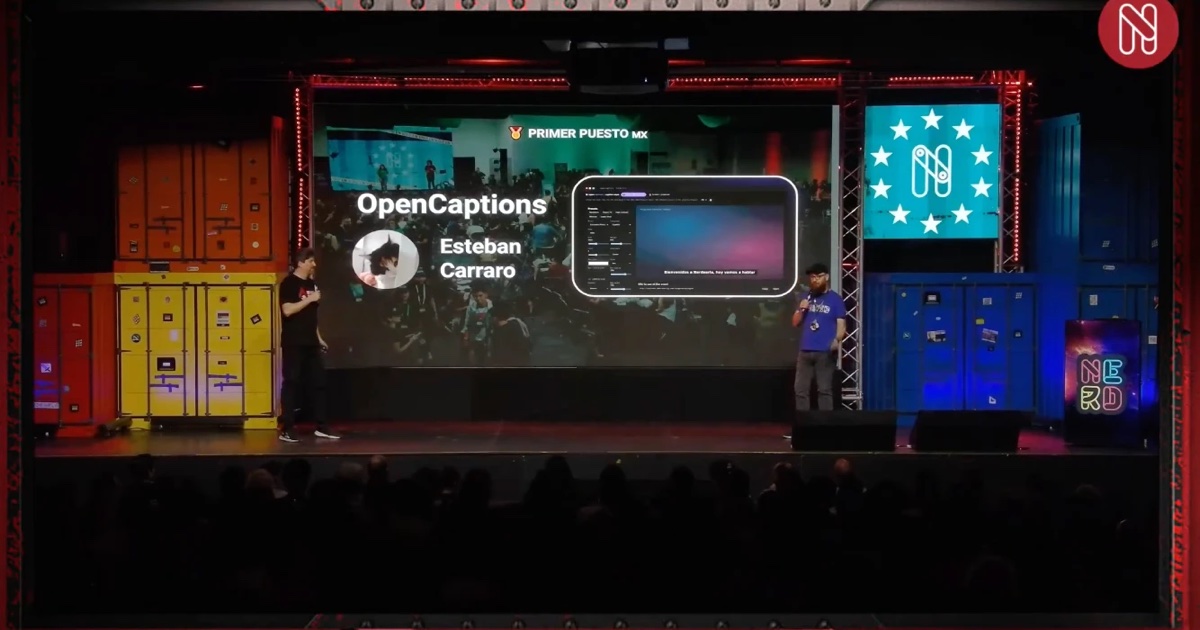
On Saturday September 26, as the event closed, we announced the winners live from the main stage:
- First place: OpenCaptions, by Esteban Carraro
- Second place: Glosa, by Martin Paladino
- Third place: VozViva, by Matías Guido
- Special mention: Subdearla, by Byron Agila
How they got there
Esteban found out "a few days before, on Discord, I can't remember if it was the general channel or me nosing around the Nerdearla ones". He had been following the conference since 2023, but in his own way: "I leave it on in the background while I do something else; very Gen-Z of me".
Hackathons? None: "I had never taken part in one; I don't have that competitive streak of making something with my own hands so that it beats someone else's".
Martin heard about it from the host of one of the workshops held in the Santander building. He had been going to Nerdearla for years with workmates, and in 2024 he even recorded a talk for Nerdearla México. "I had never done a hackathon, but I had been wanting to". The decision was made over lunch: "We kept talking about the Vibeathon idea, throwing around what we could build, and I got hooked, I wanted to try, so I said 'all right, let's see what comes out'".
Matías is not a developer. A colleague told him on Thursday afternoon, just as the clock started running. "Her words were: 'Mati, sign up, this one is for you'. I'm not a dev and I don't have deep technical knowledge, but I've been an enthusiast of this technology for years. This was the first time I signed up for anything like it".
Byron has followed Nerdearla on Instagram from Chone, in Manabí, Ecuador, and has not been able to attend in person yet. He had already taken part in other challenges and hackathons, and this one lined up with something he had been exploring: "Audio processing and transcription of large volumes of video with Whisper and local models".
Why this challenge
What drew all four in was the combination of a real problem with an excuse to learn.
For Esteban, the first thing was impact: "Wanting to help, to have that impact on a place that welcomed me with open arms. Building the application I built was satisfying: watching it take shape from scratch, with my feedback. But the application itself wasn't what motivated me; it was that I could give them my time and my tokens, and that you could use it for your events". It also helped that the challenge required no prior experience: "That you don't need the faintest idea of how to center a div, that you can give your feedback to an AI, with no skills at all, and see what comes out".
Martin says it plainly: "The trip to México or Chile was a big motivator. But so was the challenge of seeing whether a coding assistant could get me to the goal, with something that actually worked, in 24 hours, and on top of that the product they were asking for was interesting".
Matías thought about people close to him: "The push of the challenge and the clock. I thought about what people close to me need, to make it more complete in terms of features they might value at an event. It struck me as a good cause, a thoroughly well-chosen one".
Byron had the two things he enjoys most: "An interesting problem and the chance to learn something new while building. I've spent a good while experimenting with the Gemini APIs on personal projects, but I hadn't explored their real-time transcription and translation capabilities enough".
The first hours: spec first, code later
All four started the same way, and it was not by writing code.
Esteban copied and pasted the full brief and told the AI: "Ask me questions. We have 24 hours". The decision that later proved key was to leave the local version as a future feature and bet on Google's model, "and also, on purpose, so the juror from Google would like that I used theirs". And one choice he now tells with a laugh: "I didn't click 'Use Python (more robust)', I clicked 'Use the lightest option (recommended)'".
Martin spent the opening stretch generating the specifications for the final product. "I started by telling the AI the requirements, I asked it to also go through everything being said in the Discord channel to see if there was any extra information worth having, and to research everything available on transcription models. With that we started brainstorming: the AI threw ideas at me, I gave it feedback, until we had a plan I was happy with. From there the AI wrote the product spec, and only then did I ask it to write the code".
Matías, who does not come from development, sums it up like this: "In the age of vibecoding and agentic development, the main thing is the definition. At the start it was a lot of back and forth to get what I wanted to build down into a plan. Once I had the MVP, I started thinking out of the box and testing extras that weren't required. The main thing wasn't my technical knowledge, it was getting the need down on paper (or into a txt)".
Byron started from what he already knew, Whisper and transcription systems, and made an early architecture decision: "To design an architecture that didn't require opening a separate connection for every viewer, but instead processed the audio of each room and distributed the results. I also wanted it to be simple to use, ideally straight from the browser, with no complicated installs".
The 24 hours
The four experiences had little of the tidy about them and a lot of the small hours.
Esteban meant to start at noon and leave it running, but ended up starting at eight in the evening, "after a nap once I finished work". A detail of timing saved him: "The latest Claude model had just come out and I had one usage reset left, which brought me back to life". At three in the morning on submission day he started talking to the AI about the video; by nine it was uploaded. "There was room for improvement, but I had to accept that I had done it in under 24 hours". And one affectionate complaint for the organizers: "Then you gave everyone more time, so I put you in the Death Note (I don't like losing)".
Martin started at the Konex, between talks, and kept going "for a good part of the night at home and the next morning. The panic came when I realized there wasn't much time left and I still had to record a video. The app was ready, but making the video took me longer than I expected. Luckily, at the last minute they stretched the deadline by about two hours, so I made it without rushing".
Matías started prompting on the bus home and carried on with a full session with Claude in the early hours. The most chaotic part: "Uploading the demo and a video to YouTube for the first time". The most enjoyable: "Seeing that people who could be helped by the features I had in mind, people with reduced capabilities such as sight, found out about it and were happy".
Byron's deserves a paragraph of its own. He took part remotely from Ecuador, with one detail: "It was my fourth day with dengue. As if that weren't enough, that same night I had to travel to Quito, because the next day I was giving a talk at Google DevFest Quito. So between the dengue, the hackathon and the trip, it was quite the adventure. But fever and all, as I always say, we gave it everything!". The ending was down to the wire too: "I misjudged the timing and almost didn't manage to complete the submission on the platform. Luckily they extended the deadline by about 30 minutes and I got everything in. I came really close to missing out!".
The technical obstacle: silence
It is striking that, working separately, three of the four ran into the same problem: how the system decides that a sentence has ended.
Esteban describes it precisely: "With the cheapest Gemini model, subtitles arrived 15 to 30 seconds late when the audio came in loud from a browser tab. The cause: the system detected pauses against a fixed volume and, with loud audio, the silences never counted as silence. We changed it to compare against the speaker's own voice, and it came down to a few seconds at any volume". Then came robustness: "Wanting nothing to break silently on the day of the event: that it would reconnect on its own, that it would tell you if the transcripts weren't being saved, or if something had happened".
Byron found it on the experience side: "One of the problems with real-time transcription is that the system may wait for a person to pause before considering a sentence finished. At a conference, where someone can speak for several minutes straight, that directly affects the translation experience. To solve it, I worked on segmentation logic that could produce results without depending exclusively on those pauses".
Matías added a layer aimed at the audience: "When you click a sentence to see it instantly in plainer language, to explain the technical parts, I focused on keeping the transcript from falling behind. It took several rounds of testing to get it right".
For Martin the problem was technical terminology. "I started with the Gemini Live Translate model, which both transcribes and translates and is quite fluid, but doesn't handle literal wording or specific terms well. On the other hand there was Gemini Transcribe Live, which is good at transcribing and sticking to the terminology used, but doesn't translate. The solution was to use Gemini Transcribe Live plus Gemini Flash-Lite with a glossary of terms to translate the transcript. That option produced correct translations at a low cost, with a latency trade-off partly offset by choosing Gemini Flash-Lite, which is a very fast model. In the end both options stayed in the app, so you can try them and pick the one you prefer".
The tools
Everyone built on Gemini and everyone used some coding assistant to make it in 24 hours. The combinations, however, were different.
OpenCaptions uses Gemini Live Translate for the translated voice in real time and Gemini Transcribe Live for the subtitles. Esteban measured the cost: "It's just as accurate as Live Translate and costs about a quarter as much (around US$ 0.54 per room-hour against US$ 2.2)". For sentence-by-sentence translation and for the summaries and audience questions, Gemini Flash-Lite; and as a local alternative, Gemma 3 via Ollama, plus Whisper.
Glosa has two modes: Gemini Live Translate for the fast mode, "because in a single session it transcribes and translates very fluidly", and Gemini Transcribe Live together with Flash-Lite for the glossary mode. Flash-Lite also generates the summaries behind the "what did I miss?" button, meant for anyone arriving late to a talk. And a local mode with Gemma (TranslateGemma) "that runs on your machine without internet, as a fallback in case the connection fails".
Martin takes away a lesson: "Tests passing doesn't mean the app works. On the morning of the deadline, the room screen wasn't showing subtitles even though everything was green, and I only found it when I sat down to use it. Testing with real audio is what helped me polish the app the most".
Matías built VozViva "with Opus 5.5 alone" and a Gemini API, on his standard Claude plan. "Incredible potential at a low cost". And he adds a detail: the model thanked him when he asked for it to be included in the credits.
Byron used Claude Code as his assistant and the Gemini APIs as the foundation: Gemini Live for real-time audio, Gemini Flash for translation and processing, and Gemini TTS for voice. "Something I loved was experimenting with the voices Gemini generates. For the demo video I managed to create a narration with an Argentine accent and sync it to what was on screen". His reflection on the moment: "The barrier to turning an idea into a working product keeps getting lower. The real challenge is moving from knowing how to build something to knowing what is worth building and how it should work". That idea gave him the name Subdearla and features such as Nerd Radar, to spot the notable moments in a talk, and NerdCut, to turn them into clips.
The real test: presenting in English with your own tool
The rule of presenting in English using your own solution drew opposite reactions.
Esteban decided not to follow it, and he explains why: "I didn't present in English, precisely because I wanted to speak in my native language and have OpenCaptions be able to understand what I was trying to say, with the Gemini model. I had the script in English. I can give the presentation, but I had a cold. What can I tell you: I won't lie to you, I didn't want a nasal Córdoba-accented English".
Matías kept it short: "Honestly, it went better than I expected".
Byron took it as one more test: "My English is good, so it didn't scare me. I saw it as an interesting chance to try my own solution in a real setting. On top of that, I generated the subtitles for the demo video with Subdearla, so it was a good way to put it through its paces".
Did they expect to win?
Esteban did not: "I was expecting an honorable mention, because I could see my project was good. According to Claudio (a.k.a. Claude), I was in fourth place. I liked Glosa much better than mine, but when Glosa came second, I thought: that's my win right there". And an observation about the other participants: "I saw someone stuck on something really silly, and it was frustrating them, they wanted to do it no-code, very technical things, when the point was something else".
Martin was confident: "I had a fair amount of confidence in the project I put together, because it worked and I thought it looked nice. Still, I didn't know whether it would land in the top three".
Matías went back and forth: "When I started building it, I bet that it would. All the way through the process, I doubted the outcome. And when I uploaded it, I asked myself 'can you imagine if I win?'. I didn't know the answer".
Byron has no doubts: "Yes! I was definitely taking part with the intention of winning. My strategy was to stand out through product thinking. I didn't want to simply hand in a solution that transcribed and translated. I wanted to build something with an identity, a carefully designed user experience and features that added value beyond what was asked for". And some self-criticism: "I would have liked to spend more time on testing, on metrics and on demonstrating the technical performance of the solution more clearly. It isn't enough to build something that works well, you also have to know how to show it".
The moment of the announcement
None of the four were in the room when the winners were announced.
Esteban was on his own: "When I won I started laughing; I couldn't believe it. I hadn't told anyone and I was alone; I may have startled a couple of horses in the field next door when I shouted 'WHAAAAAT!?'".
Martin watched it live on YouTube: "I was so happy when I heard my name in second place, and the first thing I did was tell my partner and some friends".
Matías watched it with his parents: "I hadn't told them until that moment; at first I thought it wasn't real. In fact, I texted them to confirm, because I wasn't sure whether I had actually won. The happiness and the push it gave me to move forward with other projects were total".
Byron found out by email, and with a doubt: "I received an email with the gallery of winning projects and saw Subdearla in fourth place. It's only with your message that I'm getting a clearer picture of what happened. Having taken part and now having the chance to connect with you is already a great prize for me".
What comes next
OpenCaptions is still in development. Esteban has already released version 0.7. Martin sees Glosa as a personal project he can keep improving. Byron is already applying what he learned about Gemini's voices to language-teaching projects, and would like to collaborate with Nerdearla "whether that's building something, contributing to the community or taking part in one of your events". Matías came out with momentum to push on with other projects.
And for anyone hesitating to sign up for the next Vibeathon, each of them left a piece of advice:
Esteban: "You don't need to know anything, just to have judgement of your own and some patience. Nothing can go wrong, you'll always end up learning something new".
Martin: "Trying costs you nothing (beyond a few hours), and if you don't win, the experience of building something in a short time is great anyway, even if it isn't at 100%. You can keep improving it afterwards and it stays with you as a personal project".
Matías: "Sign up. Go for it. Take the step and break the ice".
Byron: "If you have nothing to lose, you have nothing to think about. Many of the best opportunities show up when we dare to put ourselves out there, experiment, get it wrong and learn. Sometimes winning means taking home a prize. Other times it means discovering something you didn't know how to do 24 hours earlier. And both are worth a great deal".
The next one is in México
Registration is already open for the Nerdearla México Vibeathon, which will be held in person on Saturday November 21, from 9 to 18, at the AWS offices in Puerta Polanco, CDMX.
This time we will build solutions for EIRA Movimiento Rosa A.C., a non-profit dedicated to the prevention, early detection and research of breast and cervical cancer. It works above all with women from rural and Indigenous communities and with women farm workers who have no access to health services.
In 2025 they reached more than 40,000 women and carried out 86,000 screenings. They also provide free wigs for cancer patients, share prevention information and donate menstrual products.
The Vibeathon is sponsored by Devin, AWS, Valkey and CNCF, and the prizes are:
- ✈️ 🇪🇸 A trip to Nerdearla Madrid (November 3 to 5, 2027)
- ✈️ 🇦🇷 A trip to Nerdearla Buenos Aires (September/October, 2027)
- ✈️ 🇨🇱 A trip to Nerdearla Santiago (April 15 to 17, 2027)