The problem EIRA brought
EIRA Movimiento Rosa A.C. is a non-profit devoted to the prevention, early detection and research of breast and cervical cancer. It works mostly with women from rural and Indigenous communities, and with farm workers who have no access to health services. In 2025 it reached more than 40,000 women and ran 86,000 screenings.
To put together a medical outreach day, EIRA proposes dates and services, coordinates with municipal governments and registers patients. Its staff fills in paper forms, enters the information that same day into Google Forms or Excel, and files the documents, often with no internet connection. And the cycle does not end with the visit: histories have to be kept, lab results managed, patients who need follow-up contacted, and impact reports written.
That is where the four challenges came from:
- A single digital record: today patients are identified by their full name, and a woman who comes four times in a year can be registered four times.
- Institutional coordination: commitment letters and requirements with municipalities, tracked by hand in spreadsheets.
- Impact consolidation: every program uses a different platform, and reports are assembled by copying files, with a risk of double counting.
- Secure delivery of Pap smear results: more than 300 a month go out over WhatsApp today, and when the account gets blocked the deliveries stop.
Whichever one teams picked, EIRA asked them to think about accessibility, intermittent connectivity, privacy, operation, sustainability and interoperability.
A single day
Saturday, November 21, from 9:30 to 17:00, at the Amazon offices in Puerta Polanco, Mexico City. 150 people signed up on Devpost and 26 projects made it to the submission deadline. The EIRA team spent the whole day in the room answering questions, which is the part that does not show up in the code: as the day started they mentioned that right then they had a team out in the mountains of Oaxaca and Guerrero, seven-hour drives away and up to three days with no signal.
Submissions closed on Devpost at 16:00, at 17:00 the teams pitched to the judges, and then the winners were announced:
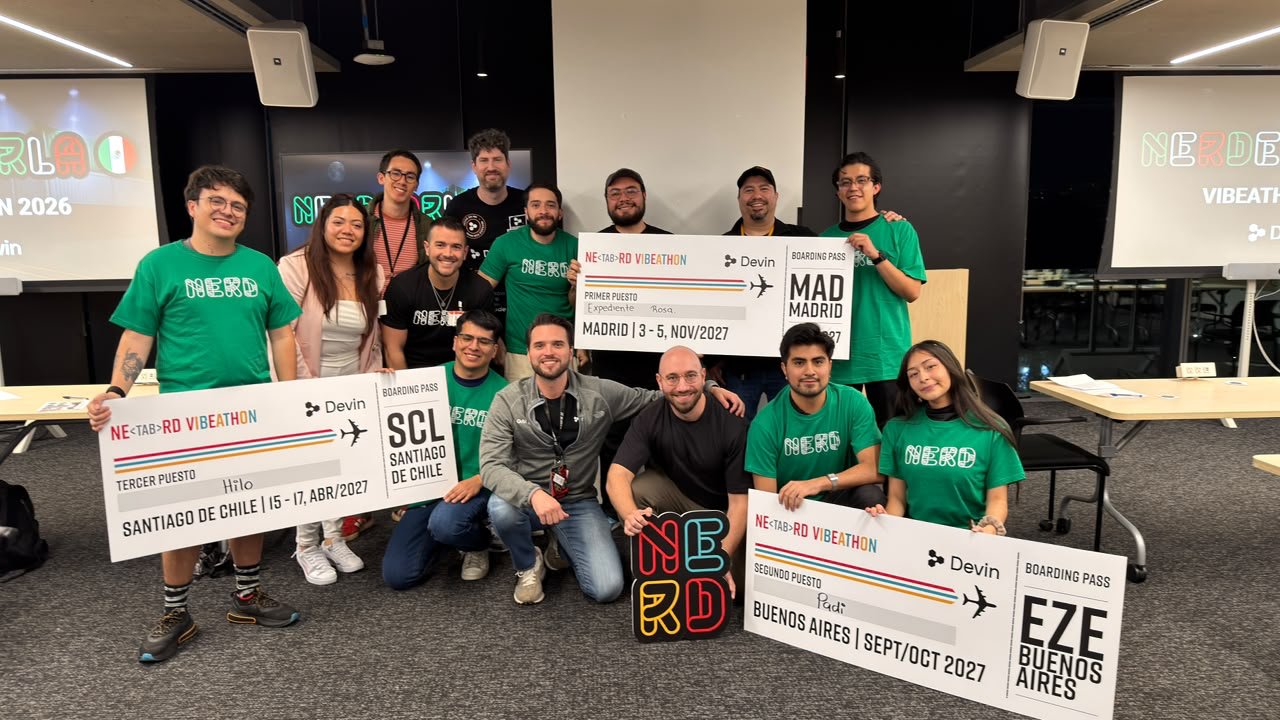
- First place: Expediente Rosa, by Jorge Iván Jiménez
- Second place: PaDi, by Diana Gabriela Delgadillo Ruelas, Christopher and Francisco
- Third place: Hilo, by Mauricio Chávez and Miguel Cariño
First place: Expediente Rosa
Jorge worked alone and picked the single patient record challenge: "One of EIRA's main problems is that when they run outreach days and don't have these services online, when they go out to the mountains and so on, it is very hard to send the data to the servers, those clinical record documents".
His solution: "Build an ecosystem for mobile apps, tablets and the web, where the data can be kept locally on your phone and, once you have a connection, sent to a back office that can manage everything".
What sets it apart is what happens when a patient returns. If one year she was written down as "Ma. del Carmen López Hdz" and the next as "María del Carmen López Hernández", nobody at the outreach day sees what was done before. The app proposes candidate matches with a score and reasons, recognizes abbreviations and nicknames, common Spanish typing errors and missing second surnames, and keeps a mother and a daughter with the same full name apart. The final call is always a person's.
Under the hood: iPhone and iPad with SwiftUI and SwiftData, Apple's on-device model to explain why two records look like the same person, Vision to read EIRA's paper forms, and an API backed by Valkey where submission keys provide idempotency, so a retry never duplicates anything. Everything works offline too; when the signal comes back, it syncs.
Jorge won a trip to Nerdearla Madrid, and his advice for anyone thinking about the next vibeathons: "Go for it. The technical side is not a requirement any more, there are plenty of tools; what is left is defining the idea really well, that is what will set you apart from everyone else. The technical part can be implemented in an hour or two, but framing the idea well is fundamental".
Second place: PaDi
Diana, Christopher and Francisco combined two challenges, the single record and the delivery of results. But what they talk about is not technical, it is human.
"The main problem, I think, is delivering results", says Diana. "Sometimes, when you get a medical result, the way it reaches you is complicated. Sometimes you don't want to open it, or you're very nervous. What we wanted was a platform where you have your results, but it doesn't stop there: you get support step by step, and if you don't want to know your results right then, you can do it later".
The system recognizes a returning patient from several fields with an explainable score, queues entries locally when there is no internet, and puts every result through two gates, administrative review and medical authorization, before releasing it. The notification never includes the diagnosis.
The team had someone at their first hackathon and someone with many behind them. Both left advice: "Be brave, be adventurous, it really is a lovely experience and you will learn a lot". "The most important thing about daring to join a vibeathon is that wish to learn, to grow as a person. I think you can build those foundations here".
Third place: Hilo
Mauricio and Miguel went for the single patient record: "It is patient data capture, simplifying the process into three easy steps: capture, verification and syncing with a database".
The application runs on the laptop used at the outreach day with the database encrypted, searches even when the name has errors and explains why it thinks two records match, but never merges on its own. Whoever does the data entry does not see sensitive history; medical staff do, and every access is logged. Nothing is deleted: visits, screenings, results and changes all live on a single timeline.
It is also the project that was most explicit about how it was built: they interviewed EIRA, defined the product and coordinated AI agents in parallel, reviewing and integrating each piece up to the demo.
"You have to go for it, literally. Building things is much easier these days, and what matters most now are the ideas". "Don't let gaining experience scare you. If you don't have the knowledge, go anyway. You will gain more than any theory can teach you".
What stays
Martí Cristobal, MC and judge for the day, summed it up: "I think one of the best ways to practice, to meet people and to learn new technologies is to take part in real projects. And what better place than one like this, a vibeathon. So, personal recommendation: if you are interested in software development, sign up for the next vibeathon you find near you".
The three winning teams are travelling to an upcoming Nerdearla: Santiago de Chile in April, Buenos Aires in October and Madrid in November 2027.
All the projects are published in the Vibeathon gallery, so anyone can pick up a piece and carry it forward. If you work at an organization with a problem like EIRA's, there are 26 different ways to start solving it.
Special thanks to Devin, AWS, Valkey and CNCF, to Roberto Luna Rojas and Abraham Alfaro, and to the team for supporting us all day long!
We will announce the next Vibeathon soon! In the meantime, you can read how the second Buenos Aires edition went.